
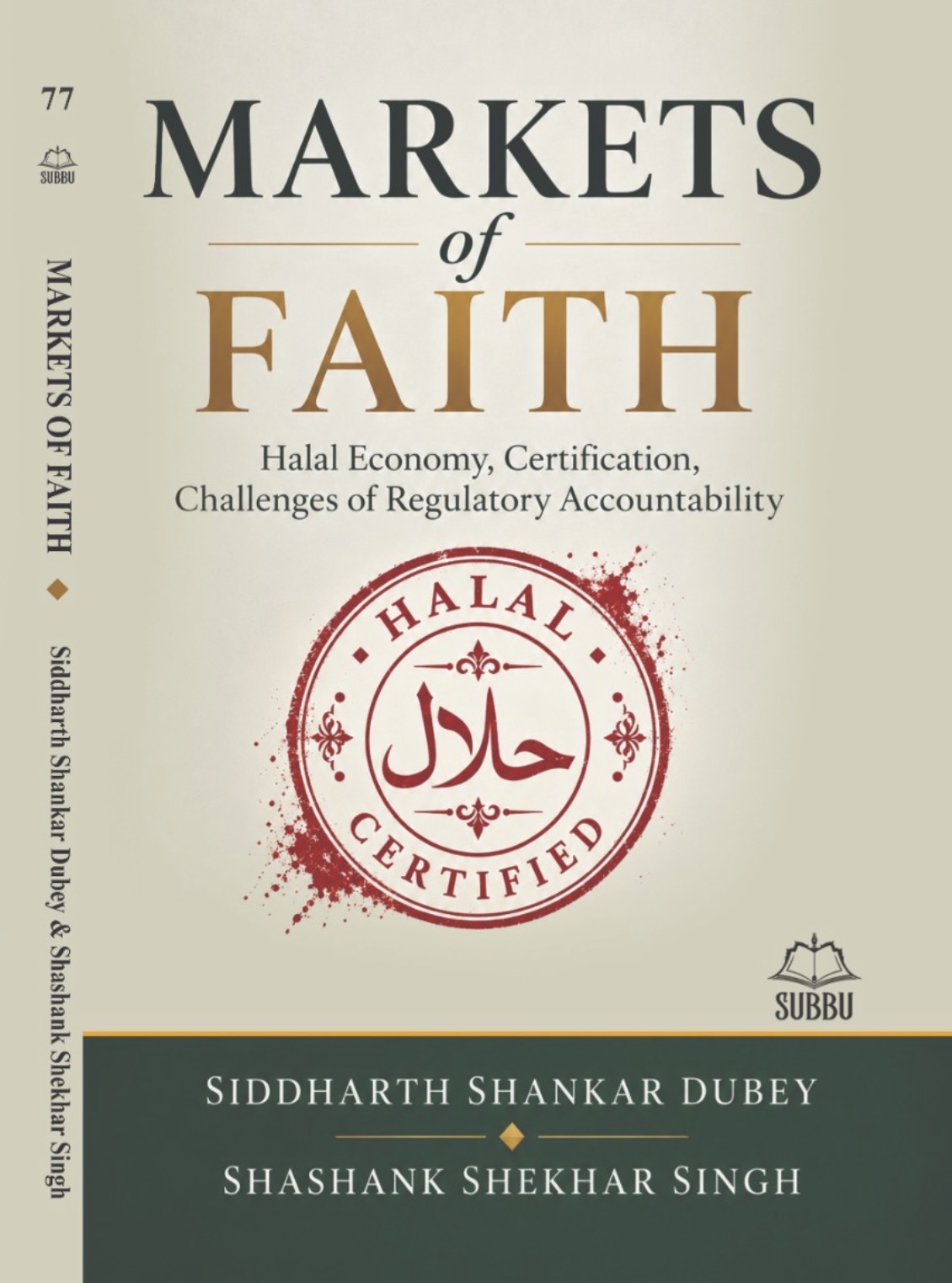
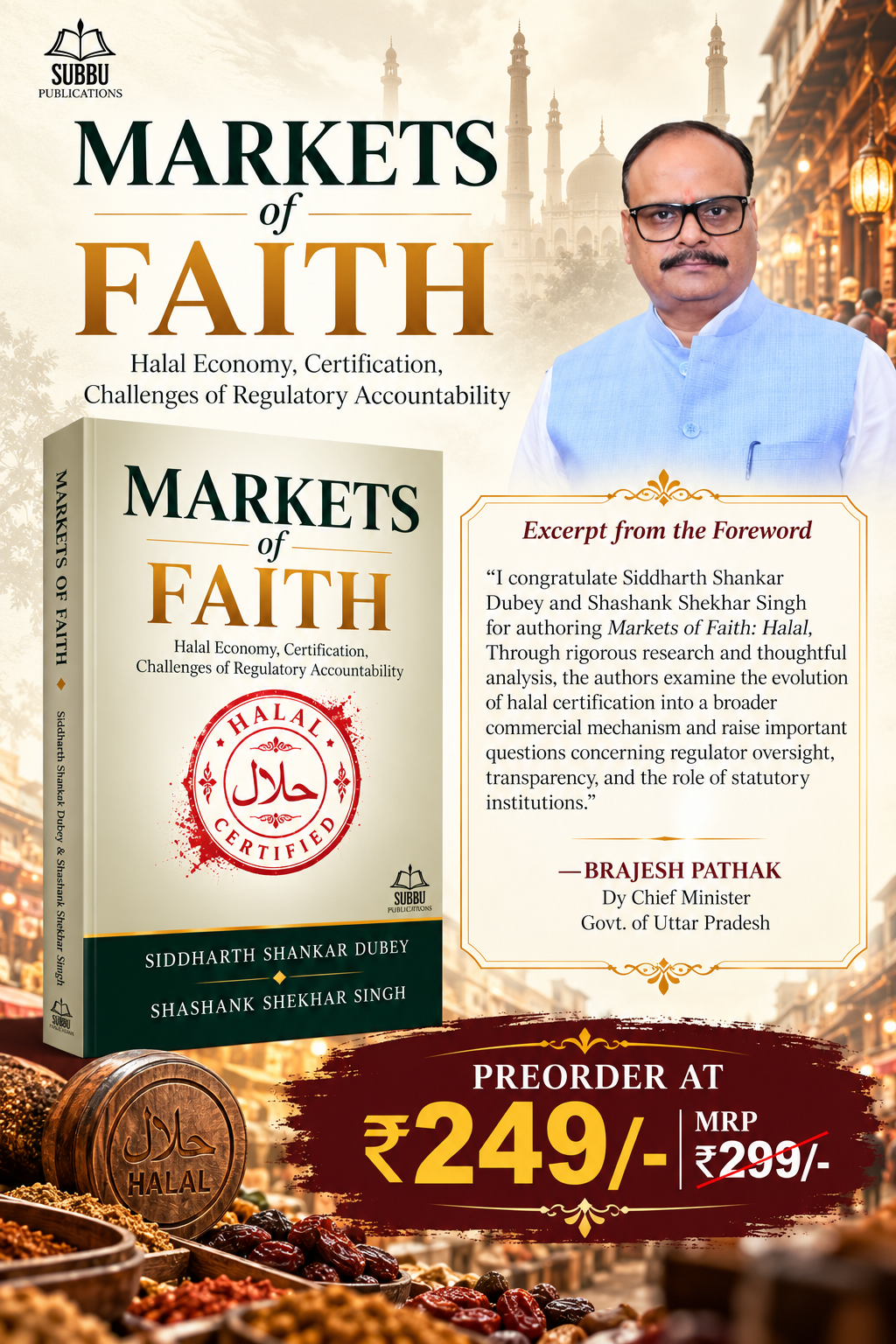
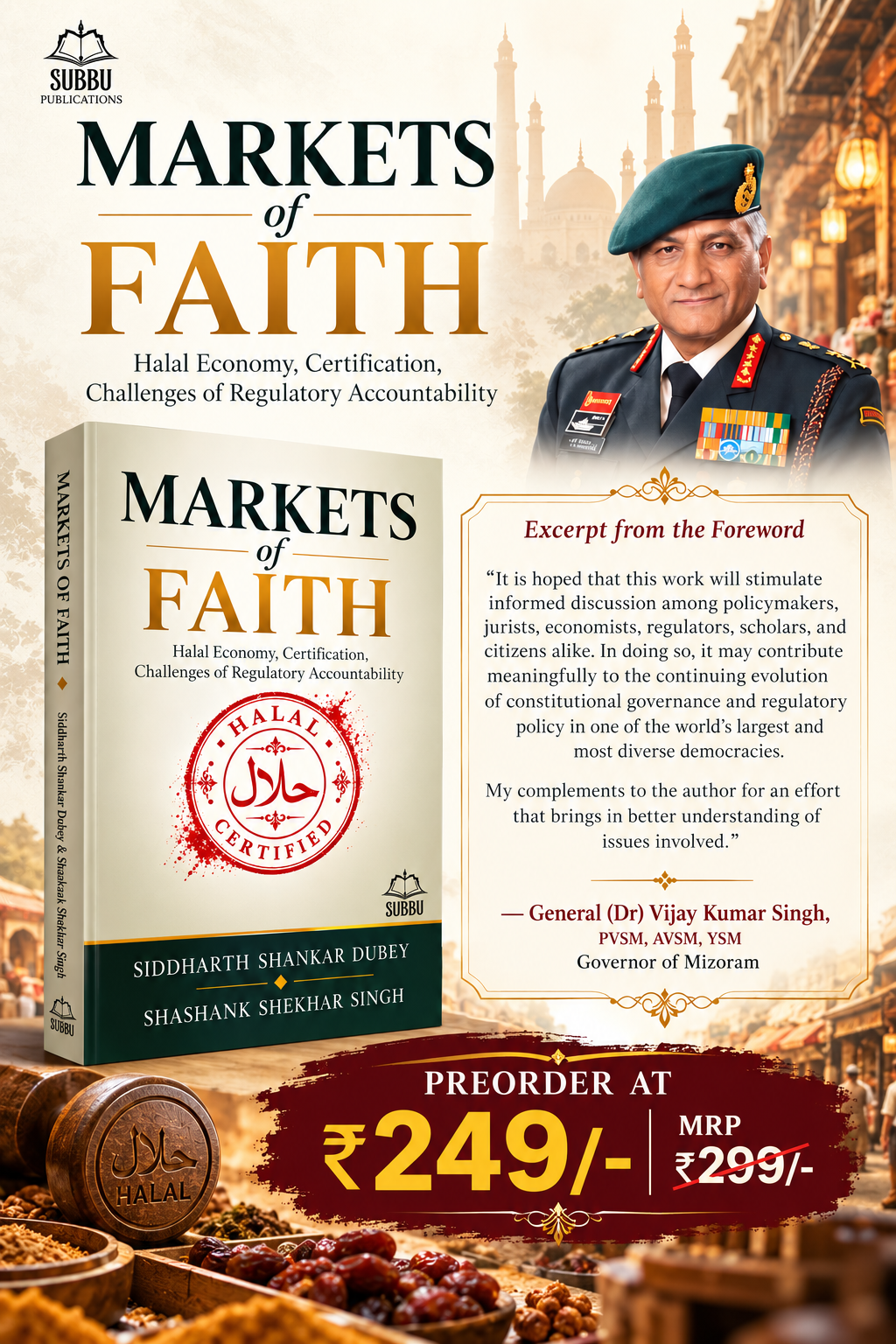
Markets of Faith, examines India’s halal certification regime as a question of economics, regulation and public accountability rather than theology. Its central argument is that a private, religion-based certification system has become a de facto market regulator, operating without legislative mandate, public audit or financial transparency.
The book carries a foreword by
Hon’ble Governor of Mizoram, General (Retd.) V.K. Singh, Uttar Pradesh Deputy Chief Minister
Brajesh Pathak, and endorsements from Abhijit Majumdar and Vishwa Bhushan.
This book begins by tracing Islam’s origins, practices, jurisprudence and history, showing that halal was traditionally a matter of personal conscience and dietary observance. It then follows halal’s transformation into a commercial category spanning cosmetics, pharmaceuticals, finance and tourism, and even goods such as cement, steel rods and bottled water.
On the economics, we rely on DinarStandard’s benchmark figures: roughly US$2.43 trillion in Muslim consumer spending in 2023, projected to reach US$3.36 trillion by 2028. They argue that certification fees pass through to all consumers as a hidden charge, segment markets along religious lines, and create financial flows that escape public accounting. Key evidence includesthe Solicitor General’s January 2025 submission to the Supreme Court that collections run to “a few lakh crores,” a figure the certifiers dispute.
The book also draws on the November 2023 Hazratganj FIR against four certifying bodies and the February 2024 arrests of Halal Council of India office-bearers, consistently describing these as allegations pending adjudication.
The book contrasts statutory certification under FSSAI and BIS with unregulated halal certifiers that set their own fees and standards. It treats export accreditation under the DGFT and QCI’s i-CAS Halal scheme as the only area where the State has imposed order. Legally, it argues that halal certification exists in a statutory vacuum and may amount to misbranding. It also argues that the regime strains secularism, State neutrality, equality and consumer-protection principles.
Uttar Pradesh’s November 2023 ban is presented as a secular corrective, with its constitutionality pending before the Supreme Court.
The concluding section proposes five reforms:
1. Statutory regulation only for domestic commerce.
2. Accredited certification confined to exports.
3. Mandatory audits and fee disclosure for certifiers.
4. Stronger consumer-protection rules on labels.
5. A clear national policy on religious certification in commerce.
Our attempt is to candidly weigh the costs of each remedy:
• Transparency presupposes a regulator to report to.
• State administration entangles government in religion.
• Prohibition leaves exports untouched.
• Anti-coercion law is hard to prove.
• Accreditation risks becoming a rubber stamp.
We have also tried to explore the tension between export needs, which require more certification, and domestic restraint. Its been argued that religious freedom is reciprocal: consumers who do not want religious certification should not pay for it silently or lose uncertified alternatives. The book closes not with a conclusion but with “a charge”: a call for continuous public vigilance.
Six appendices supplement the argument:
A: anti-halal movements worldwide.
B: a 47-jurisdiction register of global certifiers.
C: a verified list of Indian certification bodies.
D: rulings and submissions from India, Europe and the United States.
E: anonymised field interviews with a manufacturer, cleric, lawyer, policy analyst, fintech founder and consumer.
F: a certifier’s client register showing certification of industrial chemicals, pharmaceuticals and packaging materials.